A Rotterdam hotel: “We only charge by the hour.” – “Oh.” Awkward.

Rotterdam — Amsterdam’s grittier cousin.
© Stephanie Glaser

Visiting the Red Light District in Amsterdam is like going to an amusement park: lots of twinkly lights, displays and crazy characters in abundance. Additionally, a Dutch friend once told me that you’ll find a bigger police presence there than in the rest of the city. Consequently, it’s surealistically safe. Indeed, Amsterdam is well-known for the Red Light District and the more tolerant attitude toward drugs and “sin.”

Rotterdam’s vices, on the other hand, are a little less Vegas. It has always seemed a bit more gritty to me. For example, I actually experienced my first sighting of someone smoking crack in a phone booth – in broad daylight on a quiet city street. Of course, Rotterdam is one of the largest port cities in the world – so there’s bound to be a seedy element somewhere in the city.

Continue reading

Night of the Living Dead — or rather, roo road kill

Get off the road! Don’t go into the light…

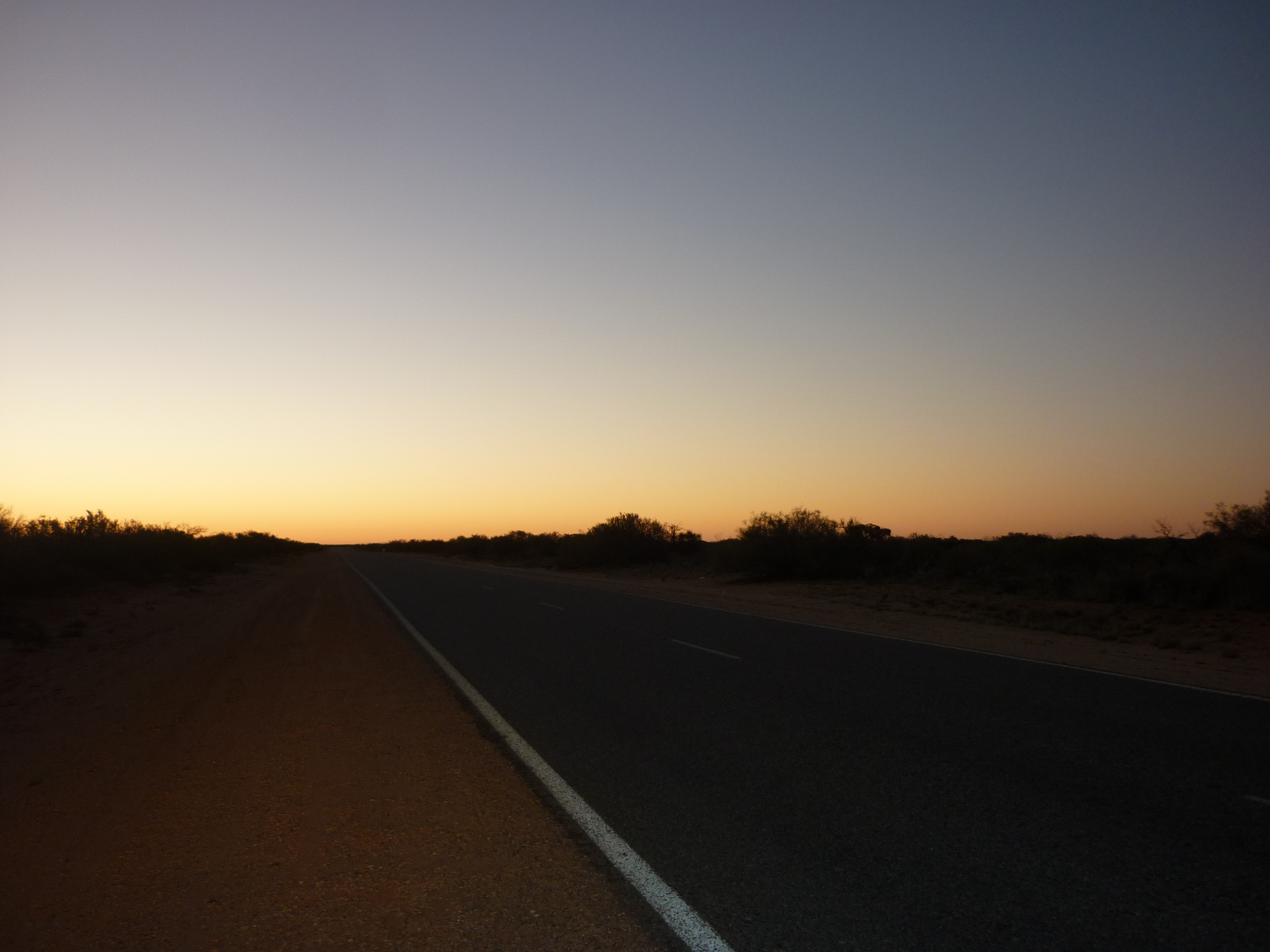
When Australians, who are generally straight forward, tell you not to drive in the bush or outback at dusk, listen to them. They know what they are talking about. And they’re talking about kangaroos and camels — but mostly kangaroos — in the headlights. Kangaroos constitute most of the road kill in Australia. In fact, many Australian vehicles have large metal “roo guards” on the front to protect the radiator in case of a hit. Our rental caravan, however, merely sported the logo of the company.

Driving from Perth, Western Australia to Exmouth, WA, is a haul. Western Australia is huge and it’s easy to misjudge distances. Kurt and I found ourselves in the outback at dusk and then dark with no sign of any towns for several hundred kilometers. Yikes!

Here they come. This isn’t even at the height of roo crossing time.
© Stephanie Glaser

Continue reading

Trying to Like Vegemite

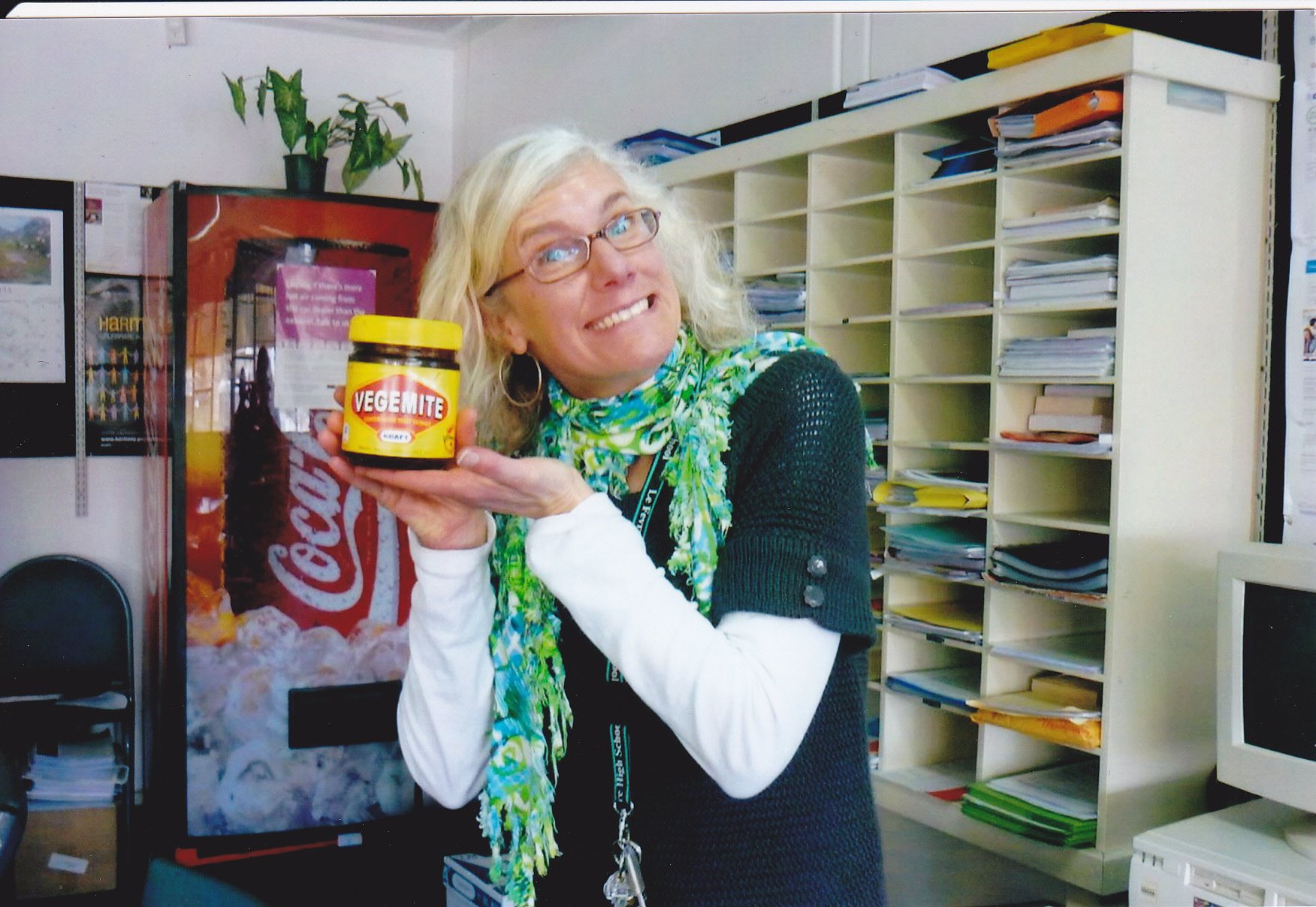
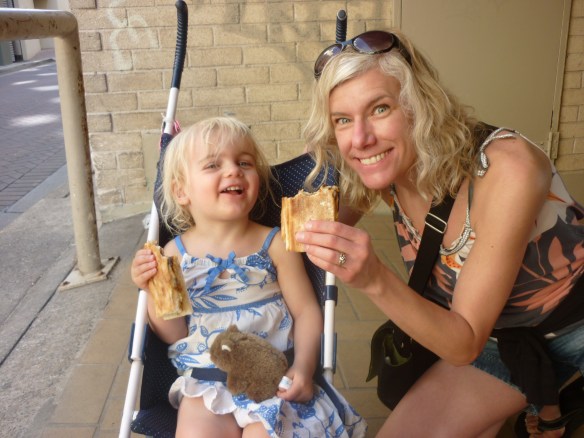
She just smiled and gave me a Vegemite sandwich!

The Turkish toast looked dubious. Among the slightly browned crevices pooled with butter, gathered substantial globs of the brown swamp residue looking Vegemite. Because I was so eager to embrace Australia (I had a kangaroo burger later that day), I ignored the fact that I really wanted to gag after taking a bite. Certainly, my tongue swirled and retracted inside of my mouth. The most beloved product in Australia tasted like congealed soy sauce.

In high school, I was a huge Men at Work fan. So, of course, on my first day after moving to Australia, I had to have the Vegemite sandwich that Men at Work so proudly touted in the song “Down Under.”  At a small cafe in Manly Beach, Sydney, my husband, Kurt, our kids and I ordered our first “brekkie” in Oz.

With more enthusiasm than necessary (jet lag), I asked for Turkish toast topped with Vegemite. After I revealed to the cashier that I had never had this classic Aussie product, the cashier said she, too, was new to Vegemite since she had moved from Brazil just two months ago.  Then she admitted that she hated the Aussie spread, but she suggested that I might like it.
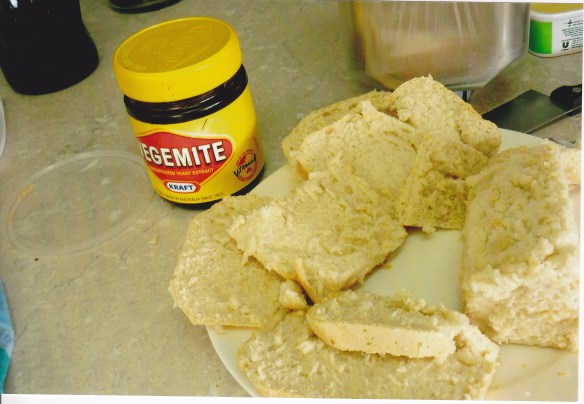
Home-baked, fresh bread — a must for Vegemite

I made it through half the sandwich before concluding — “Okay, enough. I’ve given it a go.” Truthfully, it was hard to believe Vegemite was Aussie comfort food. After all, it is Australia’s equivalent to peanut butter. In fact, some babies are weened off the breast straight to Vegemite.

After leaving Sydney and arriving in Adelaide, South Australia, to work as an exchange teacher, I was confronted with the reality of Vegemite regularly. The yellow jars are ubiquitous. While camping in the Flinders Range of South Australia, Kurt, the kids and I even encountered people who not only brought the familiar jar of concentrated yeast extract, but also they slathered it on their pancakes. Yikes!

The product really isn’t marketed properly either. It’s officially considered “concentrated yeast extract” on the label. Kraft Foods, which produces Vegemite, couldn’t even change it to “Australia’s favourite spread!” or something more zippy. Plus instead of the brackish brown color, perhaps they could make it pink and throw in some rainbow sprinkles.
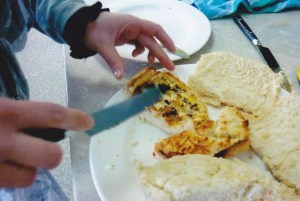
Have heaps of butter and then spread — a thin layer

However, it’s beloved as is — basically beer film with lots of vitamin B. Aussies will always tell you how soldiers during World War II ate it to stay healthy. It was also marketed to mums in the 1950s as a vitamin packed snack for kids.

Meanwhile, my students and colleagues at the Adelaide school where I taught thought it was a travesty that I had not been introduced to Vegemite properly. My fellow teachers said, of course, I wouldn’t like it when it was presented as big blobs on toast. There was technique to spreading Vegemite.

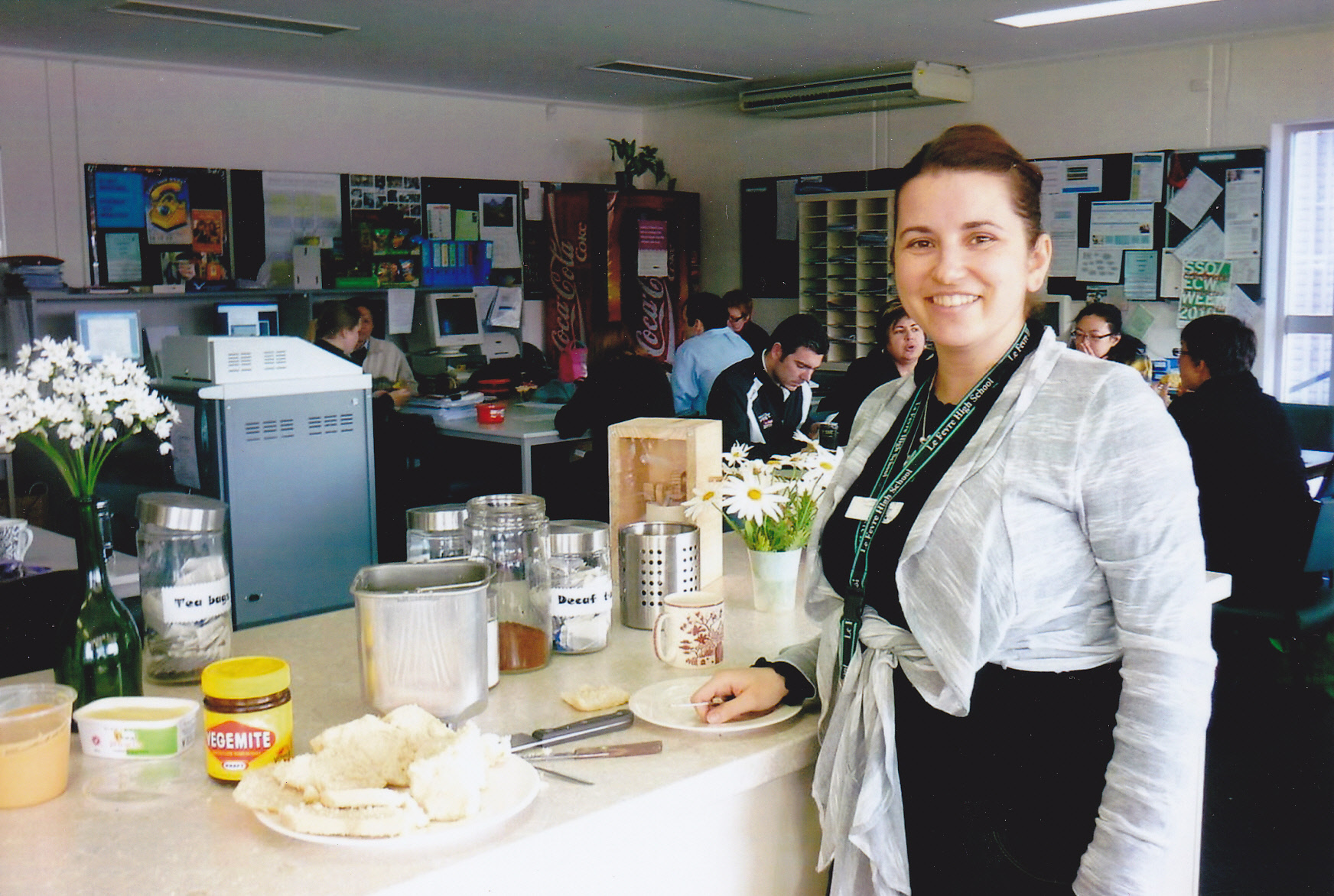
Nadine with everything she needs to convince me of the wonder of Vegemite.

My friend Kylie said I must scrape it on with the back of the knife in a thin layer. Another friend, Nadine said I needed to top it on warm, freshly made bread over “heaps of butter.”

My friend Amy, on the other hand, said to skip it. She was one of the few Aussies who didn’t like Vegemite (she’s also half American). Because I seemed skeptical, they arranged a Vegemite tasting in the staff lounge.

A bread maker arrived at school along with farm fresh butter, cream cheese, and even freshly crushed natural peanut butter (or “peanut paste” as many Aussies call it) that my friend Anne brought in my honor.  Everyone was into converting the Yank.

Finally, after trying several different thicknesses and primer coatings of butter, cream cheese and peanut paste, I decided that with enough butter, Vegemite on fresh, warm bread was pretty good. Although I might not be a full on Vegemite fan, I can tolerate it, which is saying quite a bit. And now that I’m back in the US, when I miss Oz, I have a tube of Vegemite, and I actually quite enjoy it on a piece of sourdough toast — with heaps of butter.
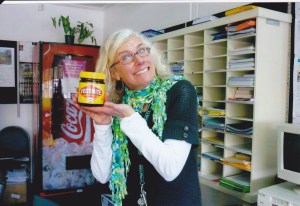
Vegemite — Yank approved

Forbidden photos in East Germany — Verboten!

Border patrol tower between East and West Germany. My forbidden subject.
Photo: © Stephanie Glaser

Let’s face it — it’s easy for an American to flub up when visiting a communist country. So many rights we take for granted are just plain illegal — like taking photos of border patrol lookout towers. Actually, this is probably frowned upon in the US, too.

Definitely, however, in East Germany in the late 1980s, taking photos of a guard tower was a bad idea. This may seem like a definite “duh!” to seasoned travelers, but for a college student who, at times, exercised bad judgement anyway, it was a cool image for a photo album.

I was the college student and the incident happened while on a train trip. I was with fellow students who were studying abroad in the Netherlands. We were on a field trip, basically, with our Dutch history professor.

Continue reading

Can you get me to the Iría?

The interior of Naxos.
Photo © Stephanie Glaser

Having just spent a week driving a motorscooter around Italy’s beautiful but treacherous Imalfi coast, justifiably, my friend Indira had picked up either bravado or a deathwish.   Consequently, she was fearless driving a motorscooter on the empty roads crossing the barren landscape of the Greek island of Naxos.

Afraid of wrecking on my moped and scraping off all my skin, I proceeded slowly.  And despite wearing the most massive helmet that the island of Naxos had to offer, one that looked like it would withstand even intergalactic travel to the Death Star, I still puttered well behind Indira and Katherine, a friend we had met on the ferry from Athens.

It didn’t take long before I became separated from Indira and Kari. Basically, I was lost. On the interior of this island, the immediate surroundings all looked the same: lots of scrub brush and an occasional windmill, goat or donkey. I stopped and tried to get my bearings. I sure seemed to be in the middle of Naxos’s nowhere.

Continue reading

This Buda’s for You — in Greek

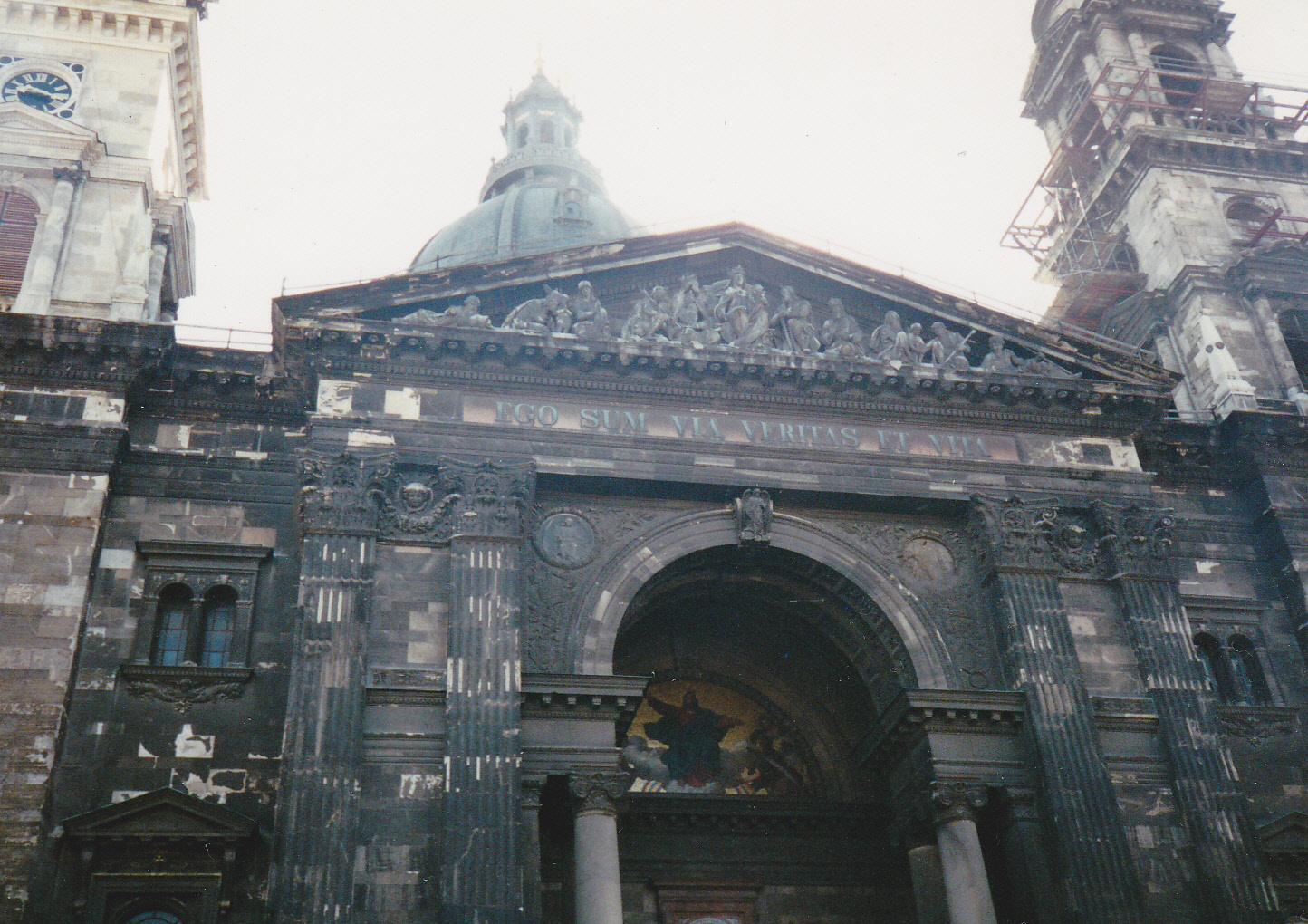
A beautiful building in Buda. I have no idea what it is.
© Stephanie Glaser

The tour minivan emerged into what had to be an important historical area of Budapest. The view from the window closest to me was of an especially stately palace adorned with statues, gates, towers, spires — typical castle stuff.   The guide began to speak, and I eagerly waited to find out what iconic Hungarian landmark I was looking at.

“There are 16 McDonalds throughout the Buda and Pest metropolitan areas,” said Gabriella, a college student from Greece, who was translating the guide’s commentary, since I was on a tour of Budapest conducted entirely in Greek.

“Huh? Are we stopping for lunch?” was my first reaction to Gabriella’s comment. However, the seriousness of her tone convinced me that this was actually an authentic cultural tidbit she was relaying. Meanwhile, the tour guide, along with the rest of the passengers consisting of Iga, a woman traveling with her seven-year-old daughter, Katerina, as well as her parents and sister, turned to assess my response. None of them spoke English. Continue reading

No skirts, no service — at least in a Greek church

Indira and I model our burlap sack chic with our Byzantine Bouncer in the background.
Photo: © Stephanie Glaser

In many countries around the world, displaying bare legs or wearing shorts when you’re a woman in a sacred place is a definite foreign faux pas. However, it is easy to forget this while traveling during a scorching hot summer in Greece.

On one particularly blistering day, on the island of Paros, my friend Indira and I arrived straight from the beach  — in shorts — to visit a beautiful Orthodox church.

Fortunately, a practical employee had provided a basket full of Orthodox sanctioned itchy, unflattering burlap looking sacks that passed for skirts.

Continue reading

Drinking poop coffee in Bali

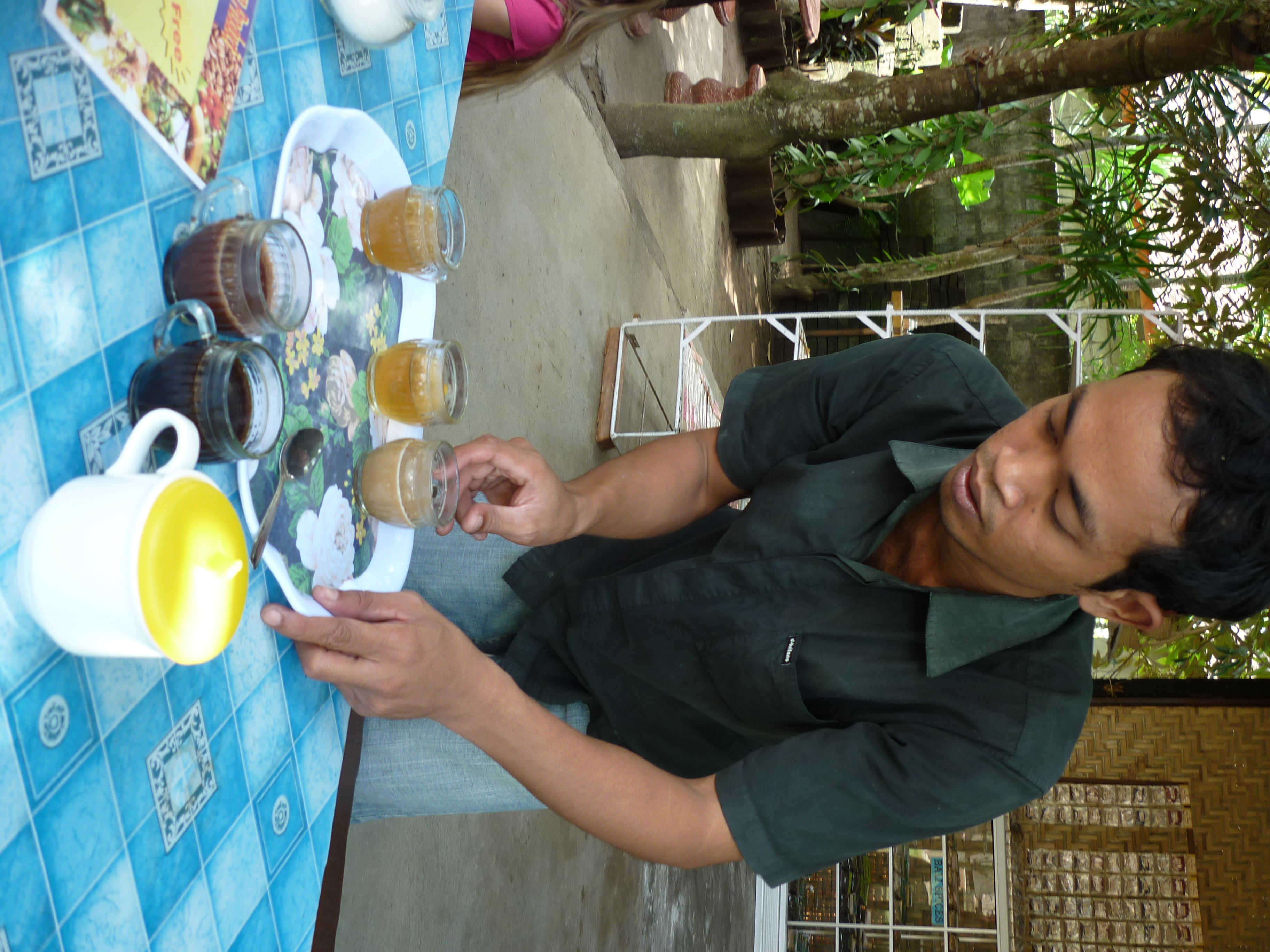
Our kind host gives us the Kopi Luwak — gulp!
Photo © Stephanie Glaser

Coffee – to me, is a delicacy wherever I am.  I love it brewed any way, shape or form. However, I didn’t realize this standard philosophy would put to the test in Bali.

When given the opportunity to visit a family compound outside of Ubud where they grew and harvested coffee, I didn’t hesitate to go and neither did my husband Kurt.  “Awesome!” was my only thought.

After touring the grounds with our kids in tow, we were invited to a tasting — essentialy heaven. Sitting at a picnic table, you leisurely sipped the many varieties of teas and coffees offered by one of the family hosts. Near the table, a hyper mongoose paced in its cage. It seemed rather random, but there was a purpose for this creature as we would soon find out.

At this particular compound, the family offered a highly prized coffee, Kopi Luwak, which is processed in the stomach of the mongoose. The coffee beans are fed to the mongoose and while he or she is digesting them, the enzymes and acids in the stomach break down the coffee, thereby eliminating bitterness.

The catch: the only way to get the processed beans is by waiting for the mongoose to poop them out. Once that has happened, someone gets to pick the beans from the dung and remove the outer layer of the bean so it is finally ready to be roasted. Our host explained this to us and gave us a brochure to read.

Frankly, it sounded like something my son Eddie made up. Like any five-year-old, most of his revelations and stories involved poop, farts, boogers or any other gross products that shoot or drain out of an orifice.

Continue reading